
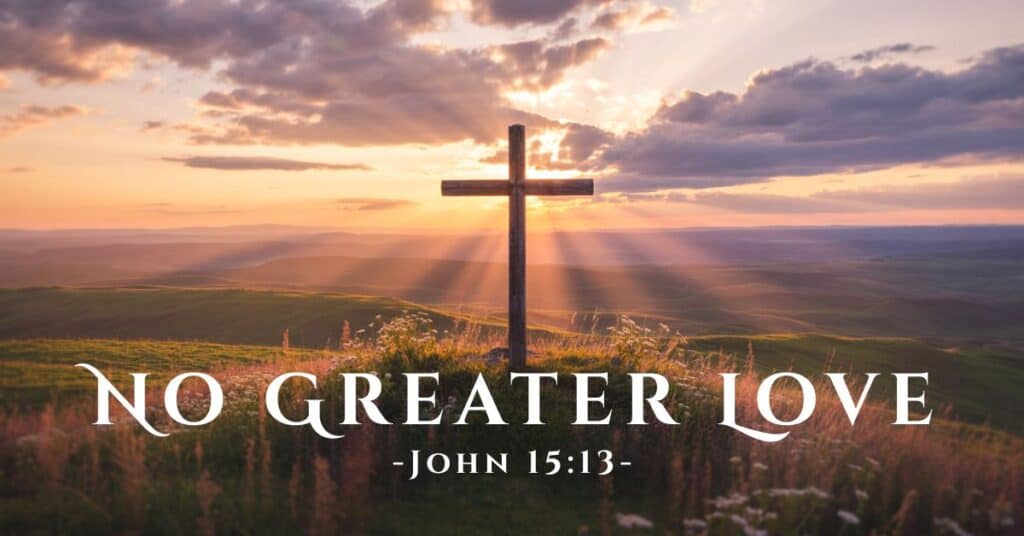
There are moments in life when a single sentence changes everything. A diagnosis. A declaration. A promise. But few sentences in all of human history carry the weight of what Jesus Christ spoke to His disciples on the night before His crucifixion. In John 15:13, He uttered words that would echo through the halls of history: “Greater love has no one than this, than to lay down one’s life for his friends.” These words were not a philosophical musing. They were a personal announcement, a promise about to be kept.
The concept of no greater love challenges everything the world teaches us about love. The world tells us love is a feeling, something warm, comfortable, and conditional. But Jesus defines love in the most radical, costly, and irreversible way possible: love is sacrifice. And not just any sacrifice. The giving of one’s very life.
The Setting: A Love Declared Before It Was Demonstrated
To truly grasp the depth of John 15:13, we must understand its context. Jesus spoke these words in the upper room, a quiet gathering with His twelve disciples, away from the crowds, away from the religious leaders who sought to destroy Him. The atmosphere was peaceful yet heavy. Jesus knew what was coming. The garden, the betrayal, the cross – all of it lay just hours away.
And yet, in that moment, Jesus chose to define love. Not to warn His disciples, not to instruct them on survival, but to set a standard, a benchmark for love that would stand as the highest measure for all eternity. He was, in essence, telling them: “Watch what I am about to do. This is what love looks like.”
There is no greater love, He declared, than to lay down one’s life for one’s friends. And within hours, He would prove it, not with words, but with nails, a crown of thorns, and a cross on a hill called Calvary.
The Standard: What “No Greater Love” Really Means
When Jesus said “greater love has no one than this,” He was not exaggerating for effect. He was establishing an absolute truth. Throughout Scripture, love is expressed in many beautiful ways, through provision, through patience, through faithfulness, through forgiveness. But all of these expressions, as wonderful as they are, fall below the supreme act of giving one’s own life.
The phrase “lay down one’s life” in the original Greek carries a deliberate and voluntary meaning. It is not the picture of someone having their life taken from them. It is the image of someone placing their life on the altar with full knowledge, full awareness, and full willingness. Jesus did not stumble into the cross. He marched toward it, arms open, because of love.
This is no greater love in its purest form: not a love that loves when it is easy, not a love that gives when it is convenient, but a love that surrenders everything, even breath itself, for the well-being of another.
The Recipients: He Called Us Friends
Perhaps one of the most overlooked words in John 15:13 is the last one: “friends.” Jesus did not say He laid down His life for the deserving, or the righteous, or the perfect. He said He laid it down for His friends. And just two verses later, in John 15:15, He makes this personal: “No longer do I call you servants… but I have called you friends.”
Think about what this means. Of all the titles Jesus could have given us, subjects, followers, disciples – He chose “friends.” A friend is someone known. A friend is someone valued. A friend is someone whose presence you seek and whose pain you feel. To be called a friend of God is one of the most extraordinary privileges ever extended to humanity.
The Apostle Paul deepens this further in Romans 5:8, noting that Christ died for us while we were still sinners, before we were worthy, before we cleaned up our lives, before we even knew His name. No greater love could be offered than love extended not because of who we are, but because of who He is.
The Fulfillment: The Cross as the Proof of Love
No verse in Scripture has a more literal fulfillment than John 15:13. Jesus spoke these words on Thursday night. By Friday afternoon, He had fulfilled them completely. He was betrayed by a friend, abandoned by His closest companions, tried unjustly, beaten brutally, and nailed to a Roman cross, a death reserved for the worst of criminals.
And yet He went willingly. In the Garden of Gethsemane, He prayed – “Not My will, but Yours, be done” (Luke 22:42) – and then rose to meet those who would arrest Him. Every step toward Calvary was a step taken in love. Every lash of the whip absorbed in love. Every nail driven in love. His death was not an accident of history. It was the greatest act of intentional love the world has ever witnessed.
The cross is not merely a religious symbol. It is the physical evidence of no greater love. It stands as an eternal declaration that God did not watch our suffering from a safe distance; He entered into it, endured it, and overcame it for our sake.
The Call: Reflecting This Love in Our Own Lives
John 15:13 is not merely something we receive; it is something we are called to reflect. Just one chapter earlier, in John 13:34, Jesus gave His disciples a new commandment: “Love one another, as I have loved you.” The standard He sets for how we are to love one another is not the world’s standard; it is His own.
Living out no greater love does not always mean physically dying for someone. It means dying to self, to pride, to comfort, to personal ambition for the sake of those around us. It means staying when it is easier to leave. It means giving when it is easier to hold back. It means forgiving when it is easier to hold a grudge. It means showing up in the unglamorous, quiet moments with consistency and selflessness.
History is filled with ordinary men and women who, inspired by this verse, lived and died in sacrificial love, missionaries, martyrs, parents, caregivers, and servants who gave everything for others. They did not do so in their own strength. They did so because they had first received the love of Christ and allowed it to flow through them.
The Invitation: Receive This Love Today
Perhaps you are reading this today feeling unseen, unloved, or forgotten. Perhaps life has made you doubt whether anyone truly cares for you. John 15:13 was written for moments like these. Before you were born, before you made a single mistake, before you ever called out His name – Jesus looked ahead to you and chose the cross. That is no greater love in its most personal expression.
You are not loved because you are perfect. You are not loved because you have everything figured out. You are loved because He is love and He has proven it in the most costly and irreversible way imaginable. The invitation of John 15:13 is simply this: receive it. Believe it. Let it transform the way you see yourself, the way you see others, and the way you live.
“The cross is not just a symbol of religion – it is the greatest love letter ever written,
signed in the blood of the Son of God.” – John 15:13 (NKJV)
There is absolutely “No Greater Love!”
Frequently Asked Questions (FAQ)
Below are common questions people ask about John 15:13 and the concept of no greater love.
Q1: What is the meaning of John 15:13 in simple terms?
In simple terms, John 15:13 means that the highest and most complete form of love is a love that is willing to give up everything, including one’s own life, for someone else. Jesus used these words to describe what He was about to do on the cross: willingly die in our place, out of love for us. It sets the ultimate standard for selfless, sacrificial love.
Q2: Why does Jesus use the word “friends” in John 15:13?
Jesus intentionally used the word “friends” to express the intimate, personal nature of His love. Just two verses later in John 15:15, He elaborates: “No longer do I call you servants… but I have called you friends.” This was a radical elevation of relationship. Jesus was not dying for strangers or for abstract humanity. He was dying for those He personally knew, loved, and chose. It is a deeply relational act of sacrifice.
Q3: How does John 15:13 apply to everyday life?
While most of us will not be called to die physically for someone else, John 15:13 calls us to a daily practice of dying to self. This means putting others before our own comfort and pride — choosing forgiveness over resentment, serving instead of being served, staying committed when it is hard, and giving generously when it is costly. No greater love is lived out in the small, daily decisions to prioritize others with Christlike selflessness.
Q4: Is John 15:13 only about Jesus, or can it apply to humans too?
John 15:13 finds its ultimate fulfillment in Jesus Christ, but it also sets a standard that applies to all believers. Jesus uses it as a template for how we should love one another (John 13:34). History is filled with examples of people, soldiers, parents, missionaries, and first responders who have laid down their lives or their comfort for others, reflecting this same principle. The verse is both a declaration of what Jesus did and an invitation to how we should live.
Q5: What does “no greater love” mean theologically?
Theologically, “no greater love” affirms that the atonement – Christ’s death on the cross – is the supreme expression of God’s love for humanity. It echoes John 3:16 and Romans 5:8, which both emphasize that God’s love was demonstrated not in words but in the ultimate act of sacrifice. It also affirms that love, in its truest form, is not a feeling but a costly, deliberate, and irreversible action taken for the benefit of another.
Q6: What other Bible verses support the message of John 15:13?
Several Bible verses complement and reinforce the truth of John 15:13:
- John 3:16 – “For God so loved the world that He gave His only begotten Son…”
- Romans 5:8 – “But God demonstrates His own love toward us, in that while we were still sinners, Christ died for us.”
- 1 John 4:10 – “In this is love, not that we loved God, but that He loved us and sent His Son to be the propitiation for our sins.”
- Ephesians 5:2 – “And walk in love, as Christ also has loved us and given Himself for us…”
- 1 John 3:16 – “By this we know love, because He laid down His life for us. And we also ought to lay down our lives for the brethren.”
Q7: How can I personally experience the no greater love of God?
Experiencing the no greater love of God begins with belief. John 3:16 tells us that whoever believes in Jesus shall not perish but have everlasting life. This love is not something to be earned or worked toward; it is something to be received by faith. Read the Scriptures regularly, especially the Gospels, to see how this love is displayed through the life and death of Jesus. Pray, worship, and surround yourself with a community of believers who can help make this love tangible in your everyday life.